
Some places aren't visited: they're experienced. A luxury trip to Salta and Jujuy is exactly that: a salt plateau that disorients the senses, multicolored gorges no photograph can translate, high-altitude vineyards where Torrontés smells of flowers found nowhere else in the world. ÉLEVÉ designs access to the version of northern Argentina that no catalog lists.
Jujuy: the Quebrada de Humahuaca and the Puna that change everything
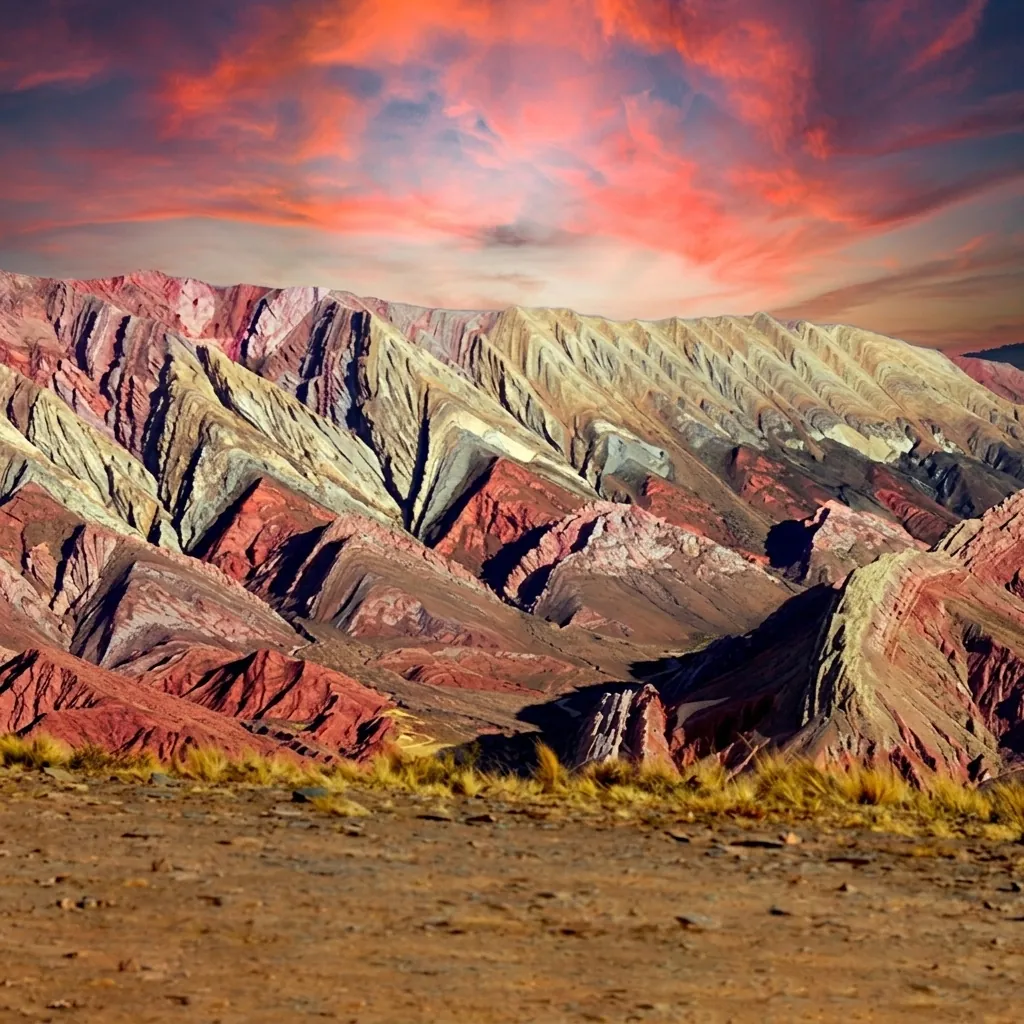
The Quebrada de Humahuaca, a UNESCO World Heritage Site since 2003, is not just a landscape: it is an experience that recalibrates perception. One hundred kilometers of Andean corridor where sediment walls hold centuries in every layer: blazing ochre, austere violet, copper green, old gypsum white. Here the traveler doesn't just look at the landscape; you inhabit it, moving at the pace set by light and silence.
At the upper end of the gorge, the Serranía de Hornocal reveals the geological wonder known as the Hill of Fourteen Colors. At sunrise, when low light touches each layer of rock and intensifies them one by one, something happens that travelers still mention weeks later with the same amazement. ÉLEVÉ arranges the sunrise visit with a private guide specialized in Andean geology; no groups, no hurry.
Purmamarca, set at the foot of the Hill of Seven Colors, is the boutique heart of the gorge. Its collector adobe hotels, built with pre-Columbian techniques, with inner courtyards and direct views of the hill, are valued for their authenticity, not their size. In the main square, the craft market gathers llama and alpaca wool textiles dyed with roots and bark: an unbroken tradition the traveler can see up close and take home.
The Jujuy Puna holds the most radical image of the north: the Salinas Grandes salt flats, 3,400 meters above sea level. Forty-three square kilometers of absolute white where the horizon disappears and sky and earth merge into a perfect mirror. The excursion is made in a private 4x4 with a bilingual driver; stops at the hand-dug extraction pools and at the geometric center of the salt flat follow the traveler's pace, not the clock.
Cafayate and its high-altitude wineries: wine that exists only here
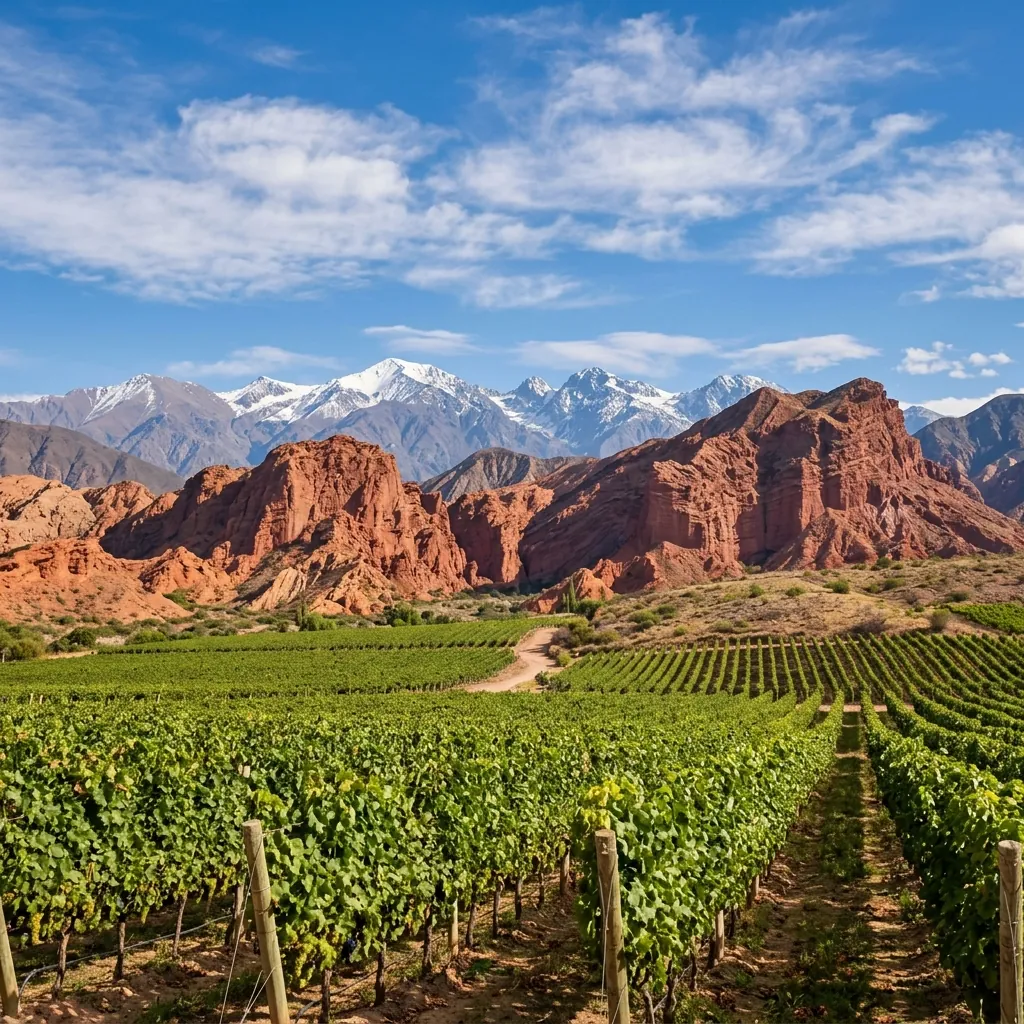
At 1,683 meters, where National Route 40 makes its most legendary pass through the Calchaquí Valleys, Cafayate produces what no other latitude can imitate: Torrontés, a white grape of extraordinary perfume born from the exact combination of sandy soils, day-night temperature swings of up to twenty degrees and an ultraviolet radiation that concentrates aromas in a way impossible to replicate. Cafayate's high-altitude wineries are not a tourist attraction; they are the land where these wines make sense.
ÉLEVÉ arranges visits to boutique wineries most travelers never get to see: small family estates on the Cafayate Wine Route, with private guided tastings. A private Torrontés tasting paired with goat cheeses from the valley, seated among the vines with the Serranía de los Colorados behind you, is a half day you won't forget.
The drive between Cafayate and Salta through the Quebrada de las Conchas adds another visual chapter to the journey: red sandstone gorges carved over millions of years by the Calchaquí River, with formations locals named the Amphitheater, the Toad and the Castles. You travel it by private vehicle, stopping whenever you like, with no rigid schedule.
Salta: four centuries of colonial elegance in the Andes
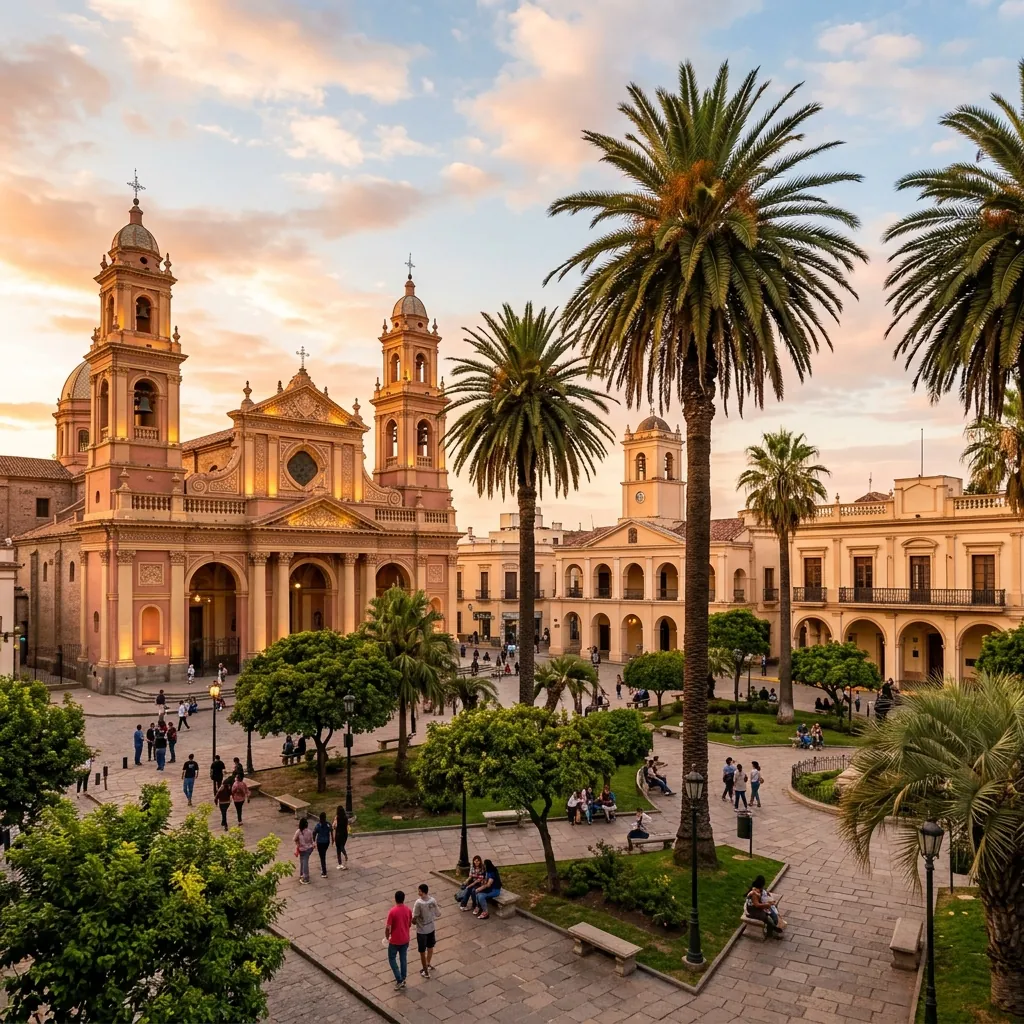
"Salta la Linda" (Salta the Beautiful) earned its nickname long before luxury travel discovered northern Argentina. Its historic center, one of the best preserved in South America, is colonial Baroque architecture in its purest form: the pink-fronted Cathedral Basilica presiding over the main square, the eighteenth-century Cabildo, and the Church of San Francisco with its crimson bell tower visible from anywhere in the city. A private tour with a guide specialized in colonial architecture brings four centuries of history to life that the facades keep quiet for the unprepared traveler.
Salta is also the starting point of the Train to the Clouds, one of the boldest high-mountain railway journeys in the world. The La Polvorilla viaduct, 4,220 meters above sea level, is a 1940s feat of engineering that is even more impressive today than it was in its time. ÉLEVÉ adds it to the journey on request, depending on the train's operating season.
The countryside around Salta holds nineteenth-century historic estates with restored manor houses, jacaranda gardens and their own produce. Sleeping at an estate, waking to the scent of damp earth and Andean silence, is to understand the human scale of a land that, seen from the road, might look like scenery alone.
- Private tasting of high-altitude Torrontés and Malbec at a boutique winery in Cafayate
- Private 4x4 excursion to the Salinas Grandes in the Jujuy Puna (3,400 m)
- Hill of Fourteen Colors at sunrise with a private guide specialized in Andean geology
- Stay at a collector adobe hotel in Purmamarca with direct views of the hill
- Private tour of Salta's colonial Baroque architecture with a heritage guide
- On request: Train to the Clouds to the La Polvorilla viaduct
The best time to travel to northern Argentina, and how to combine it
The ideal season runs from April to October. The Andean winter, June to August, is the season of light: flawless blue skies, cold nights and a daytime light quality photographers chase for years. Spring, in September and October, brings green back to the gorges after the dry rest. January and February concentrate the summer rains of the northwest; access to the Puna and the Salinas Grandes can be affected, and the experience loses some of its visual intensity.
Northern Argentina links naturally with Buenos Aires —barely two hours by air from Salta— or with Patagonia, for those who want to experience the contrast between the blazing altiplano and the glaciers of the south. ÉLEVÉ designs combined journeys that respect the pace of each destination and turn every transfer into part of the experience.
Yes. The Salinas Grandes sit at 3,400 meters and the Hill of Fourteen Colors rises above 4,000 meters. We recommend arriving first in Salta (1,187 m) or Cafayate (1,683 m), spending two nights and ascending gradually. ÉLEVÉ paces the journey so that altitude sickness doesn't affect your experience.
The most requested combination pairs three nights in Buenos Aires with seven or eight nights in the north. The Salta—Buenos Aires flight takes approximately two hours, which makes the transition very comfortable. The two destinations complement each other with perfect ease: porteño sophistication against Andean immensity. See our combined journeys for the available options.
Yes. The region has a first-class boutique offering: collector adobe hotels in Purmamarca, restored historic estates in Salta and wineries with their own lodging in Cafayate. ÉLEVÉ works only with properties chosen for their authenticity, level of service and harmony with their surroundings. We don't work with mass-market chains.
They are distinct, complementary experiences. Cafayate offers an intimate atmosphere of wineries and red desert: private tastings, silence and signature cuisine. The Quebrada de Humahuaca, a UNESCO World Heritage Site, is a corridor of Andean villages with pre-Hispanic history, living crafts and landscapes of multicolored sediment. A full journey of eight or nine nights brings both together, unhurried.